
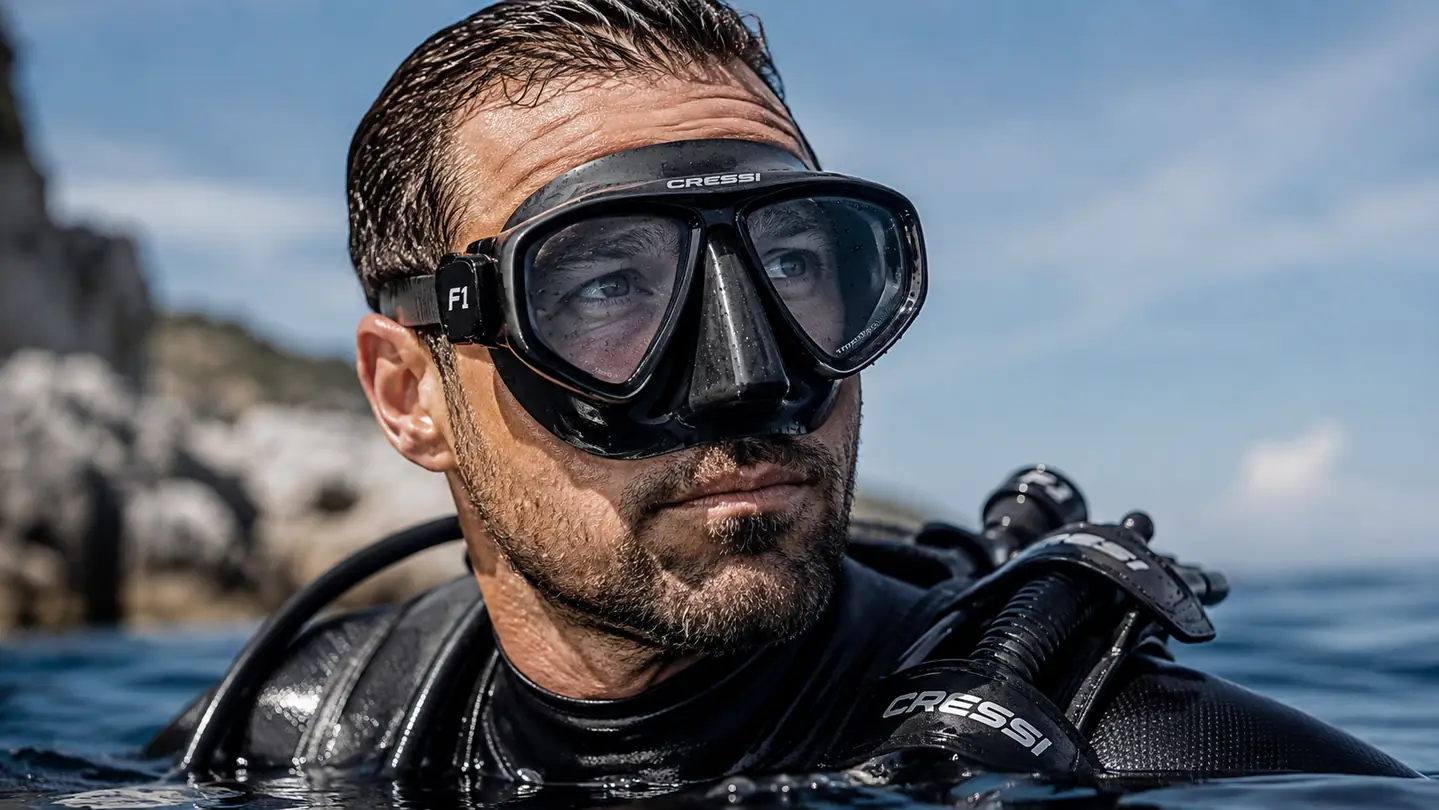
I have made my living with my hands long enough to know the first lesson the trade teaches you stays with you: the fanciest tool in the case is usually the first one to let you down. I carried that same caution into diving from my first open-water class, and it has kept real money in my pocket ever since. So when the Cressi F1 kept turning up on every boat, on every rack, and on the face of every diver who looked at home in the water, four thousand six hundred reviews trailing behind it, I did the opposite of trusting the crowd. I bought one, packed it loose in my bag the way you will pack yours, and gave it two honest years of real-world abuse. This review is about those two years: what the F1 does right, where it comes up short, and the parts the review pages will not mention.
The ten-second version before the details. The F1 is a frameless mask from Cressi, an Italian company that has built diving gear for decades, and it is the best-selling dive mask on the internet by a wide margin, for reasons that are real. But best-selling is not the same as best for you, and fit is where a mask lives or dies. A mask has to match the exact shape of your eye sockets, your brow, and your nose, and nobody else on the planet has your face. So I will tell the whole honest story: what the F1 gets right for the diver it fits, and who should walk right past it to a different design.
The Quick Verdict
The F1 earns its 4,600 reviews: the seal is outstanding on a standard face, it really does fold flat for travel, and the silicone has held up beautifully. But the nose pocket is a fixed size, the field of view is modest, and if the mask does not fit your nose, no review on the internet will fix it. Do the ten-second seal test below before you order.
Amazon Check Today's Price →Check the Mask Half the Dive World Already Owns
If a frameless mask that folds flat, seals softly, and packs into any bag is what you want, the Cressi F1 is the one with the stack of proof behind it. Run the seal test I show you down below, and if it holds, this is one of the best-value buys in your whole kit at today's price.
Amazon Check Today's Price on Amazon →How I Used It
I did not treat the F1 like a laboratory specimen, and you will not either, so this is a review from the real conditions, not a pool test. For two seasons it rode in the same dive bag as my fins and my wetsuit, rinsed off when I happened to remember, left strapped to the rail in the sun more times than I like to admit, and put under water across a wide cross-section of places. Cold quarry water in the spring, a week of boat dives where the current makes you respect a good seal, and plenty of warm mornings when I forgot I was wearing it. It has been dropped on a deck, shoved under a seat, and once kicked loose from a BCD at a surface interval.
The one job a mask has, sealing, the F1 did the whole time. I ran the test I run on any mask I might trust: hold it against your face with no strap and breathe gently through your nose. If it stays there on its own, the skirt is shaped for your face. The F1 did this from day one, and it was the same story at the bottom of a site at 70 feet. Water never came in uninvited on a single dive, and when water did trickle, a pinch of a thumb cleared it without me stopping. That is the standard every mask should meet.
After somewhere north of 180 dives, I also got to see what two years of salt water does to the parts that hold it together. The soft skirt still flexes the way it did on day one, the plastic strap clips never loosened, the glass does not have scratches across the view, and no crack has shown up anywhere. For a mask that lives in a gear bag, that quiet durability is the silent part of the review nobody name-drops, and it is one that separates value from a one-season disappointment.
Fog and equalization are the other two daily tests, so I will talk about them plainly. The F1 fogs like any mask until you burn the film off the glass, so on the first dive I work the inside with the same cleaning routine I use on every mask. After that it behaves, and it clears mid-dive with a quick breathe against the center. Equalization is easy because the nose pocket sits close enough that I can pinch the side of the skirt with one finger. Two long years, and neither of those small daily tests ever let me down.
What the F1 Gets Right
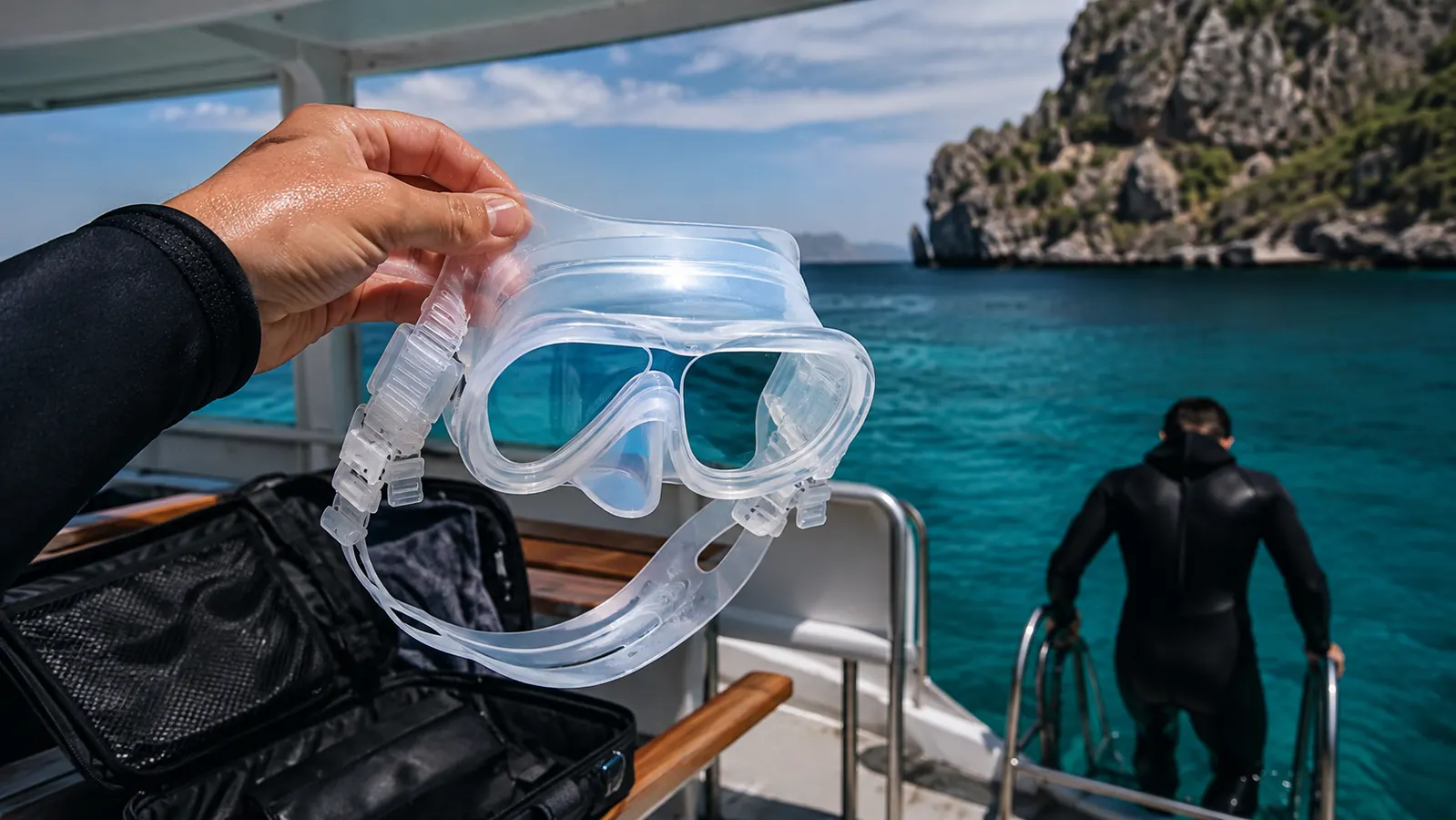
Start with the skirt, because the skirt is the whole story. A frameless mask leaves off the hard plastic frame you see on traditional masks, and the frame is where leaks start on two-thirds of the masks I have owned, wherever the plastic will not bend to the curve of your forehead. The F1 replaces the frame with a single soft edge that follows your face. The water you never lose with a skirt this good is the surest compliment you can give a mask.
It folds flat. That is not advertising words, it will flex nearly in half along the skirt and tuck into a jacket pocket or a carry-on's side pocket. I have heard it, drive, and its fold is how I pack the mask with the extra camera strap. If you travel at all, this single feature is worth real money, and it is the one you will thank by the third flight.
The build is worth naming. The mask has about three moving pieces, nothing to gum up, no frame to crack in the sun, no foam to peel. The silicone has not clouded or hardened, the glass is still clear, and the skirt holds the same softness it had on day one. Cressi has been building masks long enough to know a mask should outlast a season's tank fills. This one did.
It is also lighter than the frame masks by a real margin, and you feel it in two places. The first is when you pick it up, and the second is when the dive has gone on long enough that you stop thinking about what is on your face. A few ounces saved on the thing that presses against your ears and nose for an hour or more turns into a whole different day by the time you reach the ladder. The F1 does not nag, and that silence is a feature.
Four thousand reviewers cannot tell you one useful thing about whether this mask fits your face. The ten-second seal test costs nothing, and it is worth more than every review on the page combined.
The Weak Points Nobody Puts in the Headline
Here is the honest heart of it, and the reason this review is not just another green light. The nose pocket of the F1 fits a standard nose beautifully and no nose at all for a broad face. I have a face that matches this mask, and I can equalize with a winkle of the skirt, no problem. But I have handed it to a friend with a wide bridge and watched him struggle from the first equalization, the silicone pressed the sides of his nose and he had to work it against the skirt, and he went back to his old boxy mask before the dive was over. That is not skill, it is bone shape, and if your nose does not fit, no breaking-in will fix it.
Second, the field of view is more modest than a framed mask in the same aisle. The frameless design that lets the mask fold flat is the same design that pins the glass close to your eyes, and you cannot get one without the other. Looking straight ahead toward a reef you will not notice a thing. The difference shows at the sides, when you go to check your buddy or hold your line in a current, and you find yourself turning your head. It is a trade, and it is the one most buyers do not see until they are in the water.
Third, and smaller: the strap. The F1 ships with a perfectly good split strap and a working buckle, but it is the cheapest piece on the mask and the first thing to age. Two years of salt, air, and pinch-pulls have stretched mine, and I plan to swap it before the next trip. A ten-minute part and a cheap fix, not a swipe at the mask, but it is the one place you can feel the price being kept. You should know it going in.
None of those three reasons, taken one at a time, is a reason to pass. Together, they tell you the F1 is not a universal mask: it is an excellent mask for a particular face. When the fit matches, nothing in the price range is as comfortable, and you will do right by it. When it does not, the other four thousand five hundred reviews will not help you. That is the honest bottom of this review.
What the 4,600 Reviews Tell You, and What They Skip
The rating is real. A count that high is a signal on its own, you do not earn 4,600 reviews by accident, and the pattern is consistent: it seals, it packs flat, the skirt is soft, it stays put. I agree with the front page of the review page, and it is striking how uniform the happy reviews are across divers who dive completely different water in totally different hold.
But scroll to the low stars and one sentence repeats itself: does not fit my nose, presses on the bridge, too narrow for my face. That is the tell. When the same complaint shows up dozens of times in the pool, it is not bad luck. The M1 has nose pockets sized to a band of faces, and at the edges of that band the mask stops. Before you order, spend ten minutes reading the one-star reviews. The 4,700 glowing ones will not tell you what is about.
The value argument deserves its own line. A mask that still seals after two seasons and costs what it costs at today's price beats a mask that starts at double the money. The F1 delivers the seal, the fold, the pack, and the weight at a price that leaves room for the rest of the kit. That stack of four thousand reviews is the argument, and with the years, it holds up.
And a maintenance note to close the reviews. I rinse any mask in fresh water after a day of diving and hang it out of the sun, and I do the same with the F1, because salt pulls on silicone in the same way it pulls on a pliers spring. It is my ten-minute tool habit, and it is why the F1's skirt and straps still look the way they do at month twenty-four. Do not skip a rinse, and this mask will keep its edge for a decade.

Alternatives I Considered
If the F1 fails the seal test on your face, the answer is not a different frameless mask of the same shape, it's a framed mask or a frameless with a larger nose pocket. The two I would check first are the ones I put the F1 against side by side in a longer comparison article. It is a slow read, and it is the right one for anyone who keeps missing the fit here.
My own long-term day-to-day notes live in a separate season-long write-up on this same mask, and I will keep this page to the edge: if the fit is right the F1 is one of the best value picks in the sport, and if the fit is wrong the alternative does not matter as much as the seal test. Fit first, then price, then brand. That order has never wasted my money in diving.
One honest note about the backup idea. Many travelers buy this mask as the spare, the one that packs flat and is always in the bag, and that is a good plan when the mask fits your face. When it does not, it is not a spare, it is a leak waiting to be discovered 60 feet down with no way to fix it. Test the backup mask against your own face before it goes in the bag, exactly like the first one.
What I Liked
- Soft frameless skirt that conforms to the face it fits, no hard frame fighting your brow
- Folds flat enough for a jacket pocket, a real win for anyone who travels to dive
- Silicone survived two seasons of salt and sun without cracking or stiffening
- Plain and simple, few parts, nothing to break, easy to keep clean
- Costs less than the framed masks it beats on seal and outlasts on the right face
Where It Falls Short
- Nose pocket is sized for a standard nose and will not yield to a broad or high bridge
- Field of view is tighter than a framed mask, so you turn your head to watch the side
- The stock strap and buckle are the cheapest parts and the first thing to age
- Fit is everything, and the fit test is the one thing the 4,600 reviews cannot do for you
Who This Is For
The F1 is for the diver who wants one mask that always works, who travels light, whose face sits in the average band of nose widths, and who is willing to spend ten seconds proving it with a seal test at the shop or on a return. If the test comes back yes, you are buying a mask that will serve you for years, fold out of the way whenever it is not on your face, and never nag you between dives. That is an easy recommendation when the fit is true.
Who Should Skip It
If you have a broad nose, a high bridge, or a face you already know needs a bigger nose pocket, skip the F1 and do not let the review count talk you out of it. If you spend your dives hanging on your buddy and scanning your edges, the modest view will frustrate you more than the savings will comfort you. This is not a universal mask and Cressi does not claim it is. You are the one who has to wear it, so let the fit decide.
The Verdict, in Plain Language
Run the ten-second seal test with the rim of this mask against your face and one slow breath through your nose. If it stays, the Cressi F1 is one of the best-value mask buys you will make at today's price, and it has 4,600 reviews plus my two years behind it. If it does not stay, thank it for the honest answer and move on with no regret.
Amazon Check Today's Price on Amazon →