

I have watched grown men cuss at a dive mask for a full surface interval, crank the strap until their eyes go squint, and still spend the whole dive clearing. I used to be that guy. It took me the better part of a decade to learn what a busy dive shop clerk never has time to tell you: almost every leak is not a bad mask. It is a mask that does not sit right on your face, and the fix takes ten minutes, not thirty. Since I picked up the Cressi F1 frameless mask a couple of seasons back, I have walked a dozen divers on the boat through the same five-step routine. It has saved masks people were one dive away from throwing in the bilge.
A mask is the piece of gear you cannot fake your way past. Water in your eyes turns a good dive into a chore, and at the worst moment you cannot read your gauge or find your buddy without stopping to clear every twenty seconds. So the ten minutes you spend now are the cheapest insurance you will buy all season. Here is the routine I run on every mask I own, the same one that has kept the F1 bone dry on a hundred and twenty dives. If you are still in the market instead of already in the leak, my long-term Cressi F1 review covers two full seasons with the thing, and a separate comparison stacks it against the SCUBAPRO Spectra. This piece is the how, not the what.
You Can't Fix a Mask That Never Fit Your Face
Fit is the whole game, and the Cressi F1 is the mask that passed every step in this routine on the first try. It is frameless, it folds flat in a pocket, and the silicone skirt still seals like the day I bought it. Check today's price before you read further, then come back for the routine.
Amazon Check Today's Price on Amazon →Step 1: Do the Suction Test Before You Touch the Strap
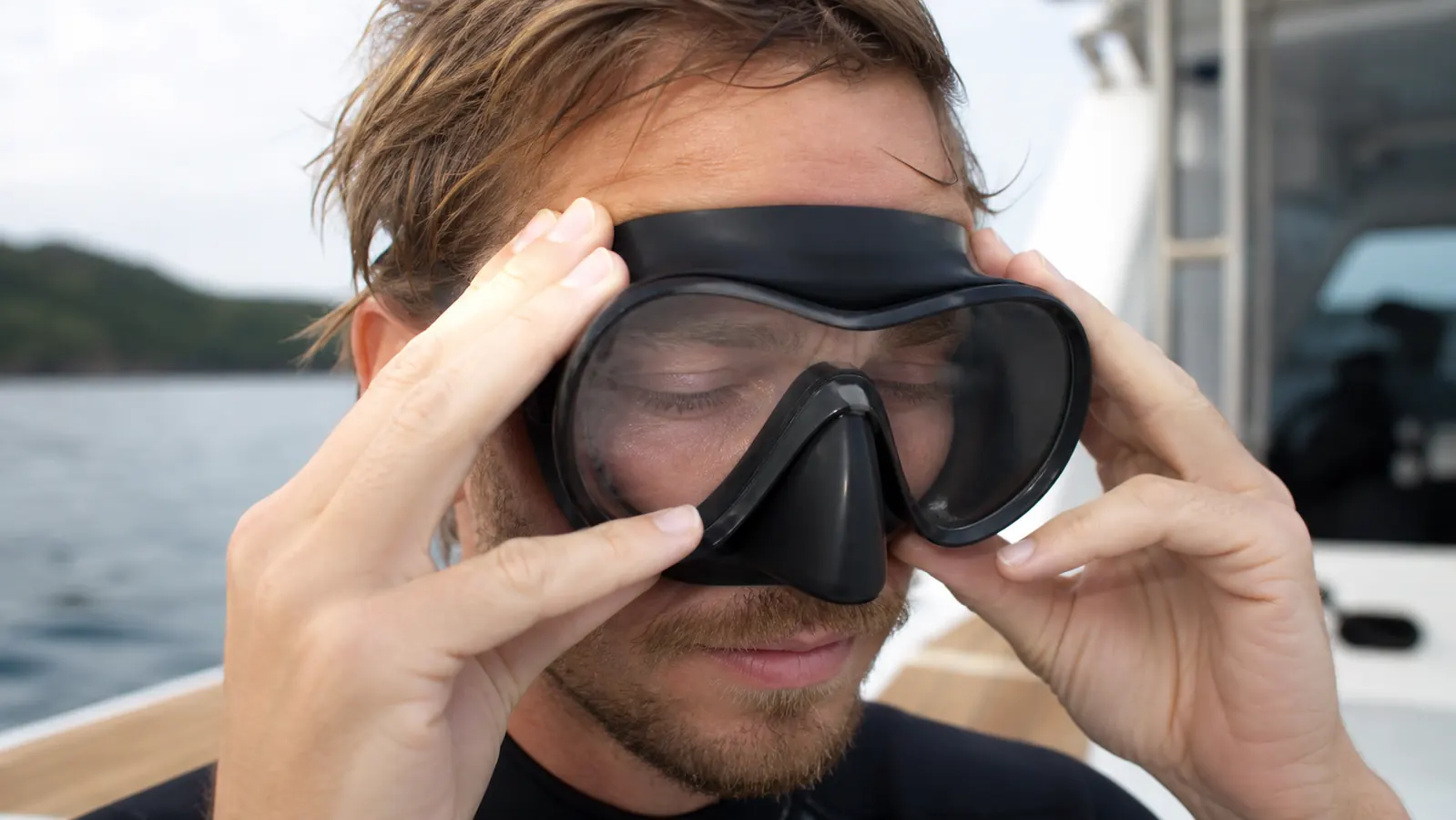
Put the mask on your face without the strap. Press the skirt lightly against your skin, then breathe in gently through your nose and take both hands away. A mask that matches your face stays stuck there on its own for a few seconds, with no strap pressure at all. That little film of suction is the whole ballgame. If the mask drops the instant you let go, no strap in the world is going to save it, because the leak is the skirt fighting the shape of your face.
While it is hanging there, check it in a mirror. Does the top edge sit even across your forehead? Does the bottom edge clear your upper lip without riding up? Move your head side to side and up and down, and keep the suction going through all of it. If the seal holds, the mask fits. If it breaks loose, you need a different skirt, not a tighter strap. This is the test I put every mask through before I hand over a cent, and it is why the Cressi F1 came home with me on the first trip.
One more thing to do while it is on your face: grin wide. A mask that fits fine when your face is slack will often lift at the corners when you smile, and that little corner gap is where a lot of so-called leaks start. Grinning now, on land, with dry hands, tells you more than you will ever learn wrestling the strap on a rocking boat.
Step 2: Get Every Strand of Hair Off the Skirt
The single most common cause of a leaky mask is not the mask at all. It is a strand of hair caught under the top edge of the skirt. Hair acts like a straw: one strand breaks the seal and lets a thin, steady stream of water run down your forehead for the whole dive. It is maddening because the leak seems to stop the moment you take the mask off, then comes right back the moment you put it on again.
So before you tighten anything, sweep your hair straight back off your forehead and tuck what is behind your ears up under the strap. If you have bangs or a widow's peak, wet them and sweep them flat. My wife dives with her hair well past her shoulders and she ties it back before she even picks up her bag. Five seconds of that beats twenty minutes of clearing water, every single time.
The same rule applies lower down if you carry any kind of face fuzz. Anywhere hair sits between the skirt and your skin is a leak waiting to happen. Get rid of it first, then blame the gear. Nine times out of ten, the mask was innocent.
Step 3: Own Up to the Mustache Problem
Here is the part every man with a mustache learns the hard way. The bottom edge of the mask seals against your upper lip, and a mustache sitting inside that seal acts like a wick. The water does not pour in, it seeps. A slow, steady tickle of seawater that never stops, no matter how hard you pull the strap.
You have three honest fixes, and I have used all three. First, trim the mustache so it sits below the skirt line; that is the option I recommend and it costs nothing. Second, wax the mustache down out of the way; it holds for a dive or two. Third, run a thin smear of silicone grease along the top edge of the mustache before you put the mask on, and let it fill the gaps the hair leaves behind. I know the grease sounds like a medicine-cabinet fix, but I watched it turn a leaky rental into a dry mask for four mustachioed divers on a wreck trip off West Palm a few years back.
If none of that appeals and you only dive a few times a year, you can accept the trickle and clear every couple of minutes. But that goes against everything I believe about gear: fix the cause, do not learn to live with the symptom. My own mustache is trimmed on the shorter side for exactly this reason, and I have never regretted it.
A guy on the boat told me his mask had leaked for nine years. I handed him my Cressi F1, walked him through the suction test, and sat him in two feet of water. He dove that mask dry for the whole hour. It was never the mask. It was the seat.
Step 4: Set the Strap Looser Than You Think You Should
Here is where almost everybody goes wrong. A mask seals by the pressure of the skirt against your skin, held there by the film of suction you felt in Step 1. The strap exists to keep the mask from falling off, nothing more. When you crank it tight, you deform the skirt, pinch the silicone, and open little gaps exactly where the water gets in. The tighter you pull, the more you feed the leak you are trying to stop.
The right setup is simple. The strap rides high on the crown of your head, not down at the nape of your neck, and it is only snug enough to keep the mask in place when you shake your head. If you can feel the strap pressing into your temples or the back of your skull, back it off a notch. On a frameless mask like the Cressi F1, the split strap sits low and cups the back of the head, which pushes the skirt into your face at the right angle without any heroic tension.
Here is the quick proof. Repeat the suction test from Step 1 with the strap barely on. If the mask still holds to your face with a light strap, the fit is right. If it only seals when the strap is yanked tight, walk back to Step 1 and look for a mask whose skirt matches your face. That single habit, checking the fit instead of the strap, has done more for my diving than any gadget I own.
Step 5: Run the Water Test Before Any Deep Dive
Last step, and the only one that happens in the water. Get into two feet of it, or use the first shallow moment of the dive, and put the mask on with the strap set the way you did in Step 4. Now take it for a tour: look up, look down, look hard left and hard right, tilt your head to each shoulder, and grin wide. If any of it admits water, resist the urge to tighten the strap. Lift the bottom edge of the skirt, let the water out, reseat the mask, and try the exact same move again.
A tiny trickle that stops when you press the top of the skirt into your forehead is usually a hair or a bit of mask squeeze, and it clears on the first sharp exhale through your nose. A leak that dumps in is a fit problem, and it will follow you all the way to sixty feet. If it dumps in, you have learned something valuable in two feet of water instead of twenty meters, which is the whole reason the test happens on the surface first.
While you are down there, do the mask squeeze. Press the top center of the skirt into your forehead and exhale through your nose. The skirt should push the air out around the bottom edge and reseat on its own. If it does, that mask is going to treat you right. Mine does, on every single dive.
What Else Helps
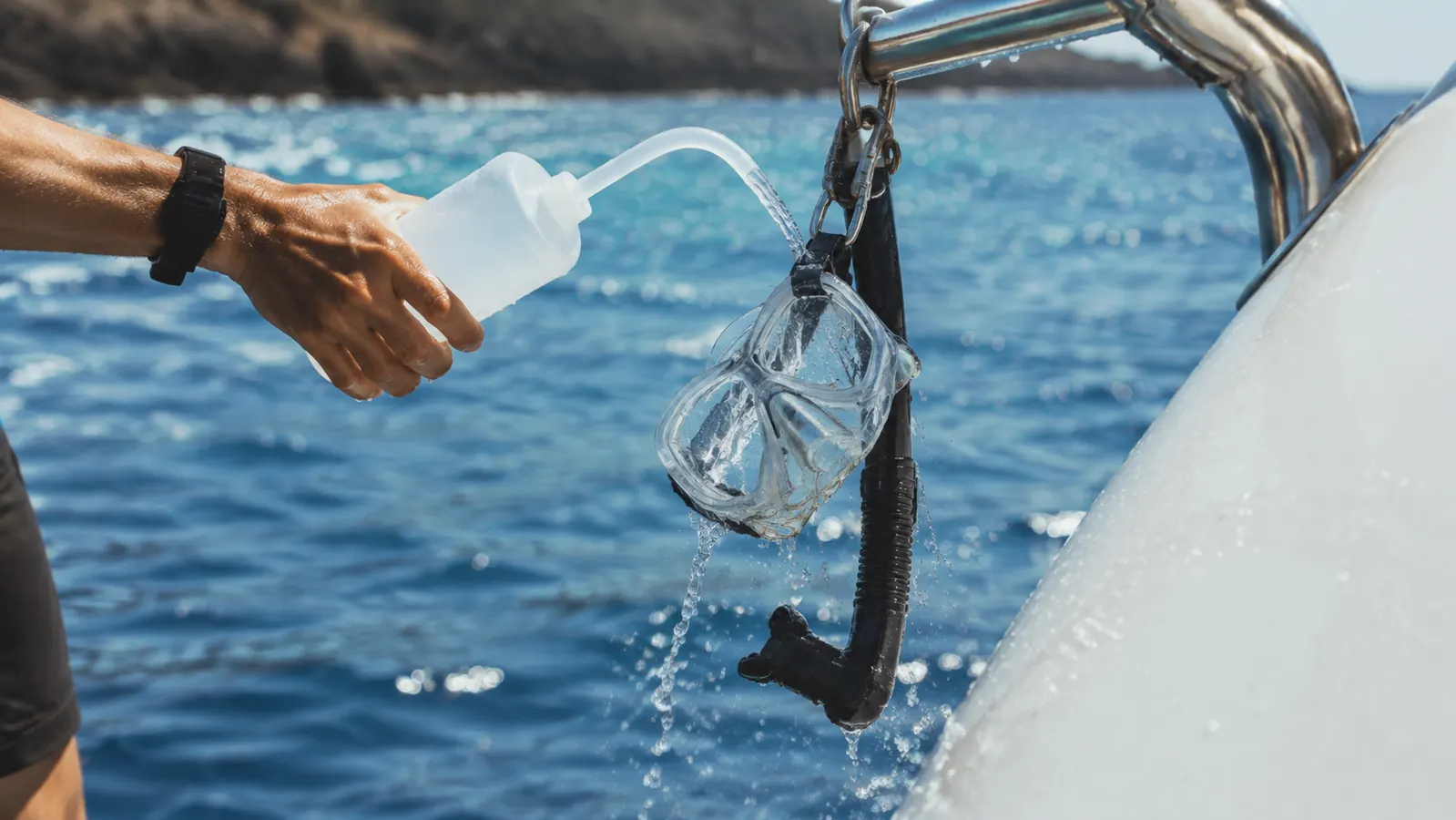
Fit is the headline, but three habits keep a good mask leak-free for years. First, rinse it in fresh water the moment you get off the boat and let it dry out of the sun. Sunshine is what turns silicone stiff, and stiff silicone is what stops sealing. I treat my mask the way I treat a good chisel: clean it, dry it, and put it away dry.
Second, do not scrub the inside of the lens with anything abrasive. The F1's lens has a factory coating that resists fogging, and the minute you scrape it off you are on the endless defog treadmill. A drop of defogging solution, or a spit-and-rinse in a pinch, plus gentle handling, keeps it working. Third, check the skirt, not the glass. A mask wears out at the lip that makes the seal long before it wears out at the lens. If the skirt has gone cloudy or stiff, it is time to replace the mask, and at the F1's price point that is an easy call.
The quiet advantage of a frameless mask is that fewer parts means fewer places to leak, and it folds flat in your bag so you never bend a frame into a permanent gap. That is reason number one why the Cressi F1 is the mask I recommend to anyone who asks, and it is not a marketing reason, it is a workbench reason. Put the routine above to use on whatever you own, and if you own nothing yet, start with something worth the ten minutes.
Ten Minutes of Fitting Beats a Lifetime of Clearing
The Cressi F1 passed every step in this routine on the first try, and two seasons of salt water have not changed that. It packs flat, it seals, and it has not leaked on me in a hundred and twenty dives. If you want a mask you fit once and stop thinking about, check today's price.
Amazon Check Today's Price on Amazon →